

Google Sachs
The RSI regime.

Not investment advice.
I began writing this two days ago, put on the trade expression yesterday, and was finalising the write up literally moments before news just hit that the elites at Google are leaving to build a purpose-built RSI (recursive self-improvement) machine. So the timing is unfortunate, but here it is anyway.
I believe RSI is about to intensify in the narrative, potentially displacing 'the frontier' as the axis the market organises winners and losers around.
In overly simple terms, RSI is AI that can build more advanced versions of itself such that it gets exponentially better at narrow things that are cheap to verify (algorithms, code, maths). It could advance at its own pace even as general capability (AGI) continues improving at its existing pace rather than accelerating with it. So they are related, but not necessarily coupled.
Speculation and hype over reaching RSI and reaching it sooner than expected is the kind of narrative regime shift you can only profit on before it’s super clear cut. So the research being more neutral than bullish but with strengthening signals is precisely the approaching-inflection point to be positioned ahead of, in my opinion. And markets do not need RSI to arrive for RSI to matter. They only need belief that the probability distribution has shifted and that it becomes the dominant AI bottleneck. In addition, after Leopold, the bull case will seek to evolve.
So how close are we?
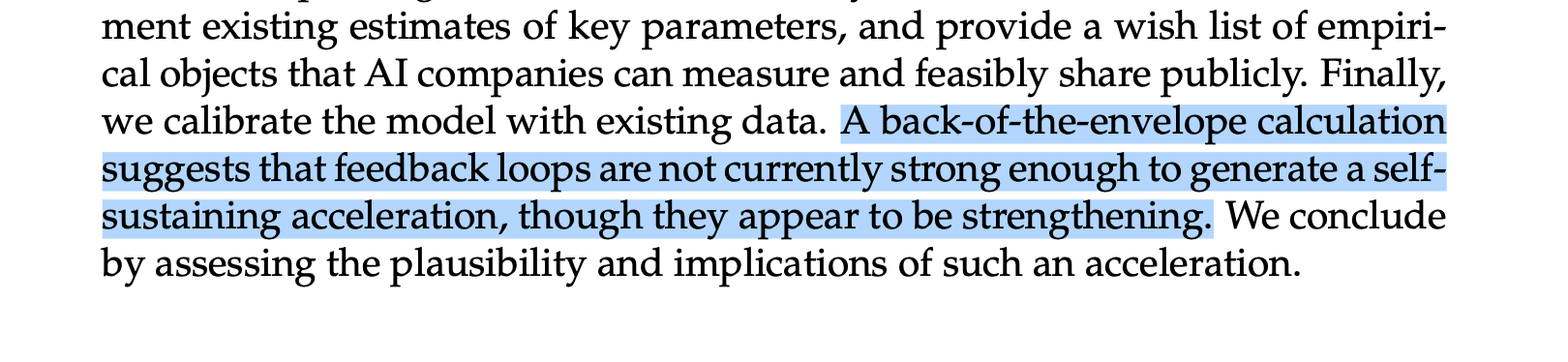
In a paper published last month, nine independent economists and researchers concluded that we are not yet experiencing RSI but the trend is rising and “Our model therefore does not rule out the possibility of self-sustaining acceleration in the near future.”
They are careful to distinguish between the definition of RSI from both ‘R&D automatability’ and an ‘intelligence explosion’ - which by the way is not the same as AGI.
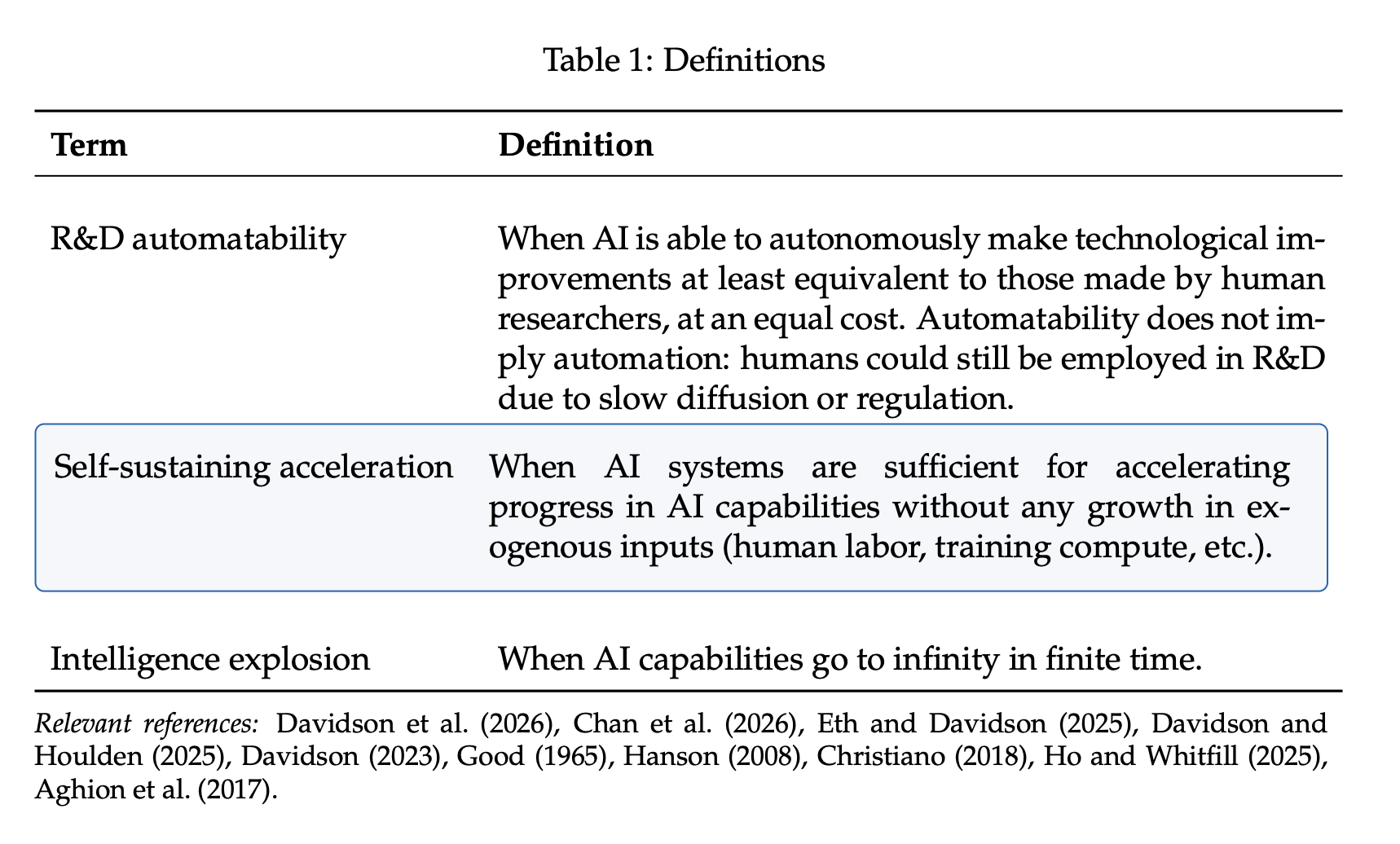
The mechanism that decouples RSI from AGI is the narrow/broad capabilities split and this split is what helped me understand what RSI actually is. RSI only requires the loop from capabilities back into algorithmic improvements, it doesn't require any arrow from capabilities into economic output. So you can get runaway acceleration in narrow capability like optimising algorithms, coding, maths, while broad capability, the general human-equivalent competence people mean by AGI, lags behind, because that depends on messier bottlenecks the loop doesn't touch.
By contrast, in the Situational Awareness thesis, automation and explosion are nearly the same event: “automating AI research is all it takes to kick off extraordinary feedback loops” and explosive acceleration. But this paper’s central technical point is that full automation doesn't imply explosion if returns diminish and bottlenecks bind, though they don't think such evidence is overwhelming, so they cannot rule out an extended and rapid acceleration. Leopold’s case rests on the effort increase being so large that it swamps diminishing returns, which is a claim about elasticities he never estimates but this paper does. This tension is probably why the market conflates these two states.
So you can think of Situational Awareness as the maximalist version of the spillover possibility this paper describes. It’s the classic extrapolation-versus-measurable divide between the visionary and the scientists.
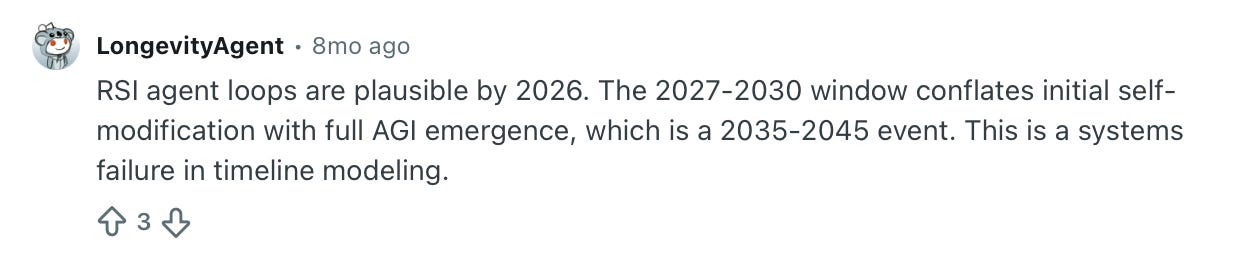
Anyway back to the timeline. The researchers think this asymmetric version (runaway acceleration in narrow capability while broad capability lags) seems plausible in the near-term, and could coexist with sluggish real-world impact. When digesting the paper’s conclusions, I wondered about historical patterns of domain experts stating a confident “not yet” shortly before the breakthrough that proved them wrong. And it’s a real pattern, often because the expert was extrapolating from the current method's limits rather than anticipating the next one. Though there is a flip side, nuclear fusion was “perpetually 20-30 years away” for seven decades running, so confident near-term misses go both directions. The RSI timeline debate could land in either camp.
“We are not there yet, and recursive self-improvement is not inevitable. But it could come sooner than most institutions are prepared for.” - Favaro and Clark (2026), When AI Builds Itself
The paper of course says nothing about tickers or sector rotation. So I asked Claude who stands to win and lose once we hit RSI.
