

Silver meta-analysis; $79: springboard or ceiling?
Synthesising 7 bulls and 4 bears/skeptics on Substack.

Additional disclaimer: I have zero expertise in silver or any commodities for that matter. I hold no strong prior view on where the price is going. This piece isn’t a recommendation. What prompted it was something the Terminal’s live feed surfaced over the past week. When a topic goes from background noise to dominant signal that quickly, it’s usually worth understanding what’s driving the chatter to get a macro read.
One more caveat worth flagging upfront: my meta-analyses usually carry very heavy editorial input from me. This one is pure Opus. I directed the research, structure and source list, but the synthesis, probabilistic read, and judgment calls about which arguments are strong or weak are the model's, not mine.
Treat it as a reading guide to the current silver conversation, and as usual, not a view of my own.
Why this moment matters
Silver is trading around $79 today — the same price it was at just before a violent round trip earlier this year. In roughly three weeks it ran to $117, a 98.9th-percentile momentum event by Elliott Gue’s measure. In February it crashed nearly 40%. By April, the entire move had been retraced.
That round trip is the subtext of every article in this analysis.
The bulls writing today aren’t predicting a first leg up — they’re arguing the post-crash base is now set and the real rally begins from here.
The bears aren’t theoretical contrarians — they called a crash that actually happened, with specific mechanisms, weeks before it did.
The disagreement isn’t abstract: bulls see $79 as a springboard, bears see it as the prior breakout level that will now cap any rally, and a third camp (Gue) sees the whole question as premature by years.
Everything below is a map of where those three camps agree, where they collide, and — most revealingly — which arguments each side refuses to engage with.
Points of genuine consensus
Stripping away directional framing, there are things almost no one disputes.
1. Silver is volatile and prone to parabolic blow-offs
Bulls treat Jan 2026 as noise in a larger uptrend; bears treat it as canonical behavior. Both agree it happens.
2. Industrial demand from electrification is real and growing
VBL’s China data isn’t contested by any bear. Even the Bitcoin Roll, the most dismissive of silver’s monetary case, concedes industrial demand — it just argues that consumption undermines (rather than supports) the hard-money thesis by destroying stock-to-flow.
3. Silver miners are historically cheap vs. the metal
Tavi Costa’s valuation point isn’t rebutted by any bear. The bears argue the metal will fall to the miners, not that miners will rise to the metal.
4. The January 2026 move was extended
Even Colombo implicitly concedes this by framing the Feb–March correction as “working off excessive froth.” Gue quantified the excess; Colombo described the cleanup. Same event, opposite framing.
Points of sharp disagreement
Fault line 1: What does “bull market intact” actually mean?

The bulls treat $79 as a springboard; Hart treats it as the prior breakout level that will now cap the rally; Gue treats “next leg” as premature by years.
Fault line 2: What actually drives silver?
Monetary/macro bulls (Oliver, Macleod, Grey Rabbit): dollar system stress, debasement, geopolitical disorder
Industrial bulls (VBL, Tavi Costa): structural physical demand from solar, EVs, batteries
Technical bulls (Colombo): price action and momentum confirm the trend
Monetary bears (Bitcoin Roll): silver lost monetary status a century ago; gold + Bitcoin fill that role now
Macro bears (Howell, Hart): liquidity cycle peaking; bond market isn’t confirming the debasement story
Cycle bears (Gue): post-parabolic momentum math overrides narrative
Notably, the industrial demand pillar is the one claim that survives bearish scrutiny. Neither Hart nor the Bitcoin Roll attacks it; they attack the monetary and speculative pillars.
Fault line 3: Is the bond market confirming or contradicting?
Hart’s sharpest argument — Treasury yields stayed stable despite debasement claim — is unaddressed by any bull in the set. Macleod gets closest (noting the physical-vs-futures oil disconnect) but frames disconnect as bullish for metals rather than as a signal that the debasement trade lacks cross-asset confirmation. Real analytical gap.
Fault line 4: Is the CME a neutral venue or an active constraint?
The Bitcoin Roll’s margin-hike argument (CME raised margins 5× in 2011 and killed that rally) is completely unaddressed by the bulls. Not dismissed — just not engaged. For anyone trading silver futures or leveraged silver proxies, this is a material risk no bull article priced in. Price Targets — Full Distribution:

The spread between the Bitcoin Roll ($20) and Oliver/Colombo ($500) is 25× — one of the widest target dispersions you’ll see in a single commodity across serious analysts. This alone tells you the market is in a regime where narrative, not fundamentals, dominates price formation.
Arguments that go unaddressed
These are cases where one side makes a claim and the other side simply doesn’t engage.
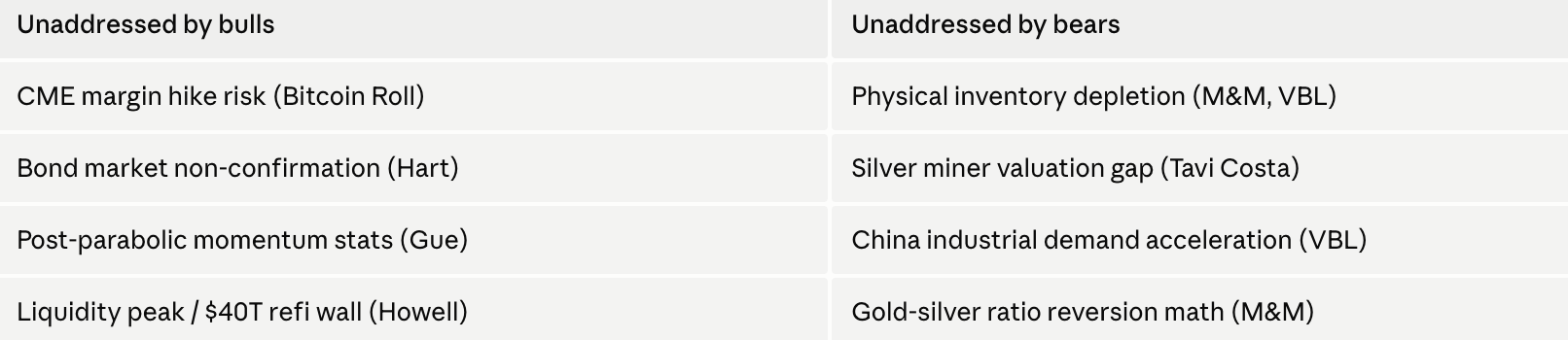
A steelman of either side would engage with the opposite column. Neither side does.
Integrated synthesis
What’s genuinely strong about the bull case
The industrial demand pillar (China, solar, EVs) and the mining valuation pillar (Tavi) are not seriously contested by any bear. If you believe in electrification and mean reversion, silver has durable tailwinds.
What’s genuinely strong about the bear case
The technical/momentum analysis (Gue) and the bond market non-confirmation (Hart) are not seriously engaged by any bull. If you believe price action and cross-asset signals matter, silver is in a multi-quarter digestion phase at best.
An honest probabilistic read
Bull base case (~40%): $79 holds, industrial demand + miner re-rate drives grind higher toward $100–150 over 12–18 months
Sideways case (~35%): Gue’s historical pattern plays out — silver chops $55–95 for years as parabolic excess resolves
Bear case (~25%): Hart/Howell right — liquidity contracts in 2026, bond market never confirms debasement, silver retraces to $40–50 or lower
The $300–500 long-term targets are not impossible, but they require the monetary-debasement narrative to reassert itself with bond market confirmation — which hasn’t happened yet. Bulls are trading a story the bond market isn’t ratifying. That doesn’t make them wrong; it makes them early, which in silver has historically meant expensive.
The variable nobody is watching
If the bull thesis at $300+ is really a dollar-debasement thesis, it needs real yields to go meaningfully negative. That’s the macro variable the next six months will settle — and it’s conspicuously absent from most articles on both sides.
The meta-observation
The most striking thing about this sample is that selection bias runs in both directions. Substack’s silver ecosystem skews heavily bullish because that reflects the audience — and the bull writers in this set are doing something genuinely difficult: building conviction around a multi-year structural thesis that requires patience and pattern recognition across cycles, supply data, and macro regimes. The bears, by contrast, are fighting for oxygen in a venue that isn’t naturally theirs, which pushes them toward a narrower toolkit — specific statistics, explicit invalidation levels, short-horizon historical analogs.
The two sides aren’t really competing on the same axis. The bulls are writing strategic, thesis-driven work (”decade opportunity,” structural supply deficits, monetary regime change) — the kind of analysis that only pays off if you hold the frame through volatility. The bears are writing tactical, signal-driven work — the kind that’s easiest to verify in weeks rather than years. Both modes are valuable, and a serious reader probably wants exposure to both: the strategic case to know why to own silver at all, the tactical case to know when the crowd has gotten ahead of itself.
MarketStack is free today. But if you value my work, you can pledge for a future subscription.
MarketStack is an independent, anonymous publication summarising publicly available commentary and views from across financial media. Nothing here constitutes financial advice or a recommendation to buy, sell or hold any security. All views are a synthesis of public information. Past performance is not a guide to future results. This publication is not authorised or regulated by the Financial Conduct Authority. The author writes anonymously in a personal capacity.
Bullish Sources
Metals and Miners — “Major Banks Predict Silver Price...” — April 20, 2026
Tavi Costa — “Silver Miners: The Decade Opportunity” — April 21, 2026
VBL — “MSA’s Michael Oliver Says Silver Will Seek $300–$500” — April 20, 2026
Grey Rabbit Finance — “Energy Destruction, Dollar Swaps and Silver” — April 20, 2026
VBL — “China’s Silver-Linked Energy Exports” — April 18, 2026
Alasdair Macleod — “Surreal Markets” — April 17, 2026
Metals and Miners — “When Is the Precious Metals Bull Market Going to Top?” — April 16, 2026
The Bubble Bubble Report — “Silver Is Breaking Out” — April 16, 2026
juniorminingpro — “Two JMP Core Holdings Dropped Critical Updates” — April 15, 2026
The Bubble Bubble Report — “What My Proprietary Indicator Says About Silver” — April 14, 2026
Bearish/Skeptical Sources
The Bitcoin Roll — “TBR #301: When Silver Bubble Pop?” — December 28, 2025@
Justin Hart — “Silver’s 40% Crash Was the Most Predictable Disaster of 2026” — February 3, 2026
Elliott Gue — “Silver’s Parabolic Surge: Why This 1% Event Triggers a Take Profit Signal” — December 29, 2025
Adam Taggart — “Bullish for Rest of 2025, But Bearish for 2026 | Michael Howell” — August 3, 2025
Very solid and, most importantly, balanced overview — exactly the kind of analysis worth reading. I appreciate that it doesn’t ignore the stronger bearish arguments (especially momentum and the bond market), which most “silver content” tends to overlook.
For me, the key takeaway is something that was more implicit: industrial demand + stagnating supply. That’s a fundamental dynamic that’s hard to ignore long term. Regardless of what price does in the short term, that pressure is there.
Timing is, of course, another matter — and silver’s history shows it can be extremely unpredictable and punish even the right thesis.
In any case, thanks for putting this together — it provides a great high-level map of the market
The bottom line -WITHOUT manipulated data giving you manipulated data results- would be metals to the moon.
Is this about to change?
You be the judge.
I wish you well.