

Substack is now just the media
Shall we just give up?

An article from nobody I follow came up in my Notes feed this morning. It immediately caught my attention — if you spend any time on this platform, 935 restacks against 2,337 likes is a freak result, the clickbait title was the tell but I’d already felt its lies in my body, I distrust anything that gets to me that fast.
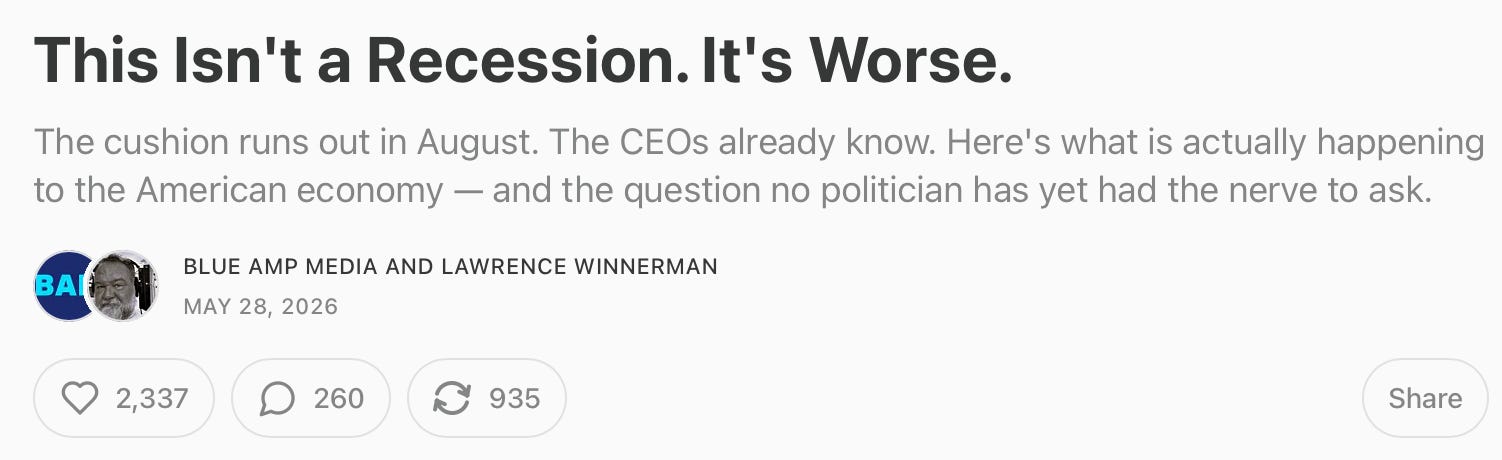
A progressive political-media Substack doing a macro-doom crossover spikes my cortisol because it leverages particularly corrosive headline engineering:
Emotional, unfalsifiable headline — “This Isn’t a Recession. It’s Worse. “Worse” is deliberately empty yet emotionally maximal. You can’t argue with “worse” because it asserts nothing falsifiable; you can only read on to find out what he means. It’s a complete, quotable thought you can restack without context.
The subhead is where the real machine is:
“The cushion runs out in August” manufactures urgency and a countdown the reader can feel.
“The CEOs already know” is the exact kind of insider hook that gets your guard down and persuades you to read on, as if he is on your side. But it’s the weakest point in the essay.
The piece is full of more dramatic lines that get your heart beating:
“There’s a tanker offloading somewhere on the Gulf Coast in the Houston Ship Channel right now.
That is what inventory looks like in the wild. The economy we are walking through this week was bought before the war…
Inventory is mercy.”
And here's the uncomfortable part: the inventory claim is true. There is a real supply shock working its way through the system — the war, the Strait of Hormuz, energy and fertiliser prices loaded at the new rate and not yet on the shelf. The lag he's describing is real.
What he does with it is the problem: he takes a genuine, dateable shock and uses it to smuggle in a second story that has no date at all. Hold that thought.
The essay says corporate America authorised $665 billion in share buybacks in the first four months of 2026, the most ever to start a year. That is correct. The actual run-rate the same source gives is closer to $1.55 trillion. So on the buyback line he’s not just right, he’s underselling his own number.
And then I got to the part that had done the most damage to me on the first read via the subhead — the CEOs. Bezos sold $5.7 billion of Amazon. Michael Dell sold $2.2 billion. Safra Catz at Oracle sold $2.5 billion.
The essay’s gloss:
“These are not the kinds of sales you make on the way up. These are the kinds of sales you make when you have access to numbers the rest of us do not yet have.”
The dollar figures are real but the frame story around them — that load-bears his ultimate claim, and what gets the re-stacks — is not.
Those are 2025 full-year totals (mid-2025 for Bezos), presented in a late-May 2026 essay as if they’re a fresh signal.
Bezos was funding his wedding
Bezos’s sale ran on a pre-arranged 10b5-1 schedule and was timed to his wedding — automatic, filed months in advance, nothing to do with reading tea leaves. And Catz was selling down on her way out of the CEO chair.
And the detail that doesn’t appear anywhere near the headline: aggregate insider selling actually fell — sharply.
Around $36 billion in the second quarter against $62 billion the year before.
The single line that made my stomach drop — the smart money knows something and is heading for the exit — is the one claim in the piece the underlying data argues against.
"The question no politician has yet had the nerve to ask" manipulates the reader with an anti-establishment framing. You're about to be told the brave thing the cowardly class won't say.
That’s the trick, once you see it. He has two completely different things going on and he welds them together.
One is a sharp, real, fast supply shock: the war, the energy and fertiliser prices, the August deadline.
The other is slow and structural: the labour share sliding for twenty-six years, work getting automated out from under people. That one doesn’t care what month it is. The share of US output going to workers hit 54.1% in the first quarter of 2026, the lowest in Bureau of Labor Statistics data going back to 1947. He loosely calls it “labour share of US GDP” when it’s really the nonfarm business measure, but the number is current and correct.
But by bolting the slow problem onto the fast one’s calendar, he gives a decades-long trend the urgency of a nine-month countdown.
Here’s where I have to be straight, because the lazy move is to find one bad citation and write off the lot, and that would be dishonest.
The structural argument is fair. The labour share really has been falling since 2000. Productivity really is climbing while wages don’t. The economists he leans on — Acemoglu and Restrepo on technology that’s “good enough to fire her, not good enough to need her,” Robert Allen on the decades British workers waited for wages to catch up to output — are real, and he uses them more or less fairly. And the question he ends on — if the wage stops being how ordinary people earn a place in the economy, what replaces it — is a serious one. He’s not a crank. That’s what makes it effective.
Which is, in the end, exactly what depresses me about it.
It would be easier if it were rubbish. It isn’t. The true parts and the manipulative parts are stitched together so tightly you can’t pull one out without the other coming with it.
The headline sells the weakest claim in the essay
“The CEOs know, the cushion runs out in August” quietly buries the strongest one, the labour share, because a number that’s been sliding since 2000 doesn’t make anyone hit restack. The better the packaging, the further it sits from the part actually worth your attention.
Political-media-doing-macro tends to spike hard on Velocity (restacks, emotional virality) while scoring low on the analytical-credibility axis.
Which is really a problem for Substack, not for one essay. The whole pitch was that it wasn’t this — that paying a writer directly would let everyone off the treadmill of chasing reach.
But the restack button and the recommendation feed are quietly rebuilding the same machine that wore everyone out everywhere else, and unless Substack decides its algorithm should reward something other than raw spread, the thing that travels will keep being the thing engineered to travel rather than the thing worth reading.
In the meantime, it’s now just another engagement farm with a nicer font.
PoliticStack
Frustration is a signal. Funnily enough I have long been working on a MarketStack-adjacent publication PoliticStack mapping and synthesising the U.S. Politics, World Politics, International and Health Politics categories — with World Politics and International grouped under Geopolitics. This viral essay has emboldened me to accelerate the launch. So I guess that answers my own subhead: no, we shall never give up!
Visit MarketStack The Edit · MarketStack Terminal
MarketStack is free today. But if you value my work, you can pledge for a future subscription. MarketStack is an independent, anonymous publication summarising publicly available commentary and views from across financial media. Nothing here constitutes financial advice or a recommendation to buy, sell or hold any security. All views are a synthesis of public information. Past performance is not a guide to future results. This publication is not authorised or regulated by the Financial Conduct Authority. The author writes anonymously in a personal capacity.
The funny thing is that this is a known fact like 2 month ago. Everybody who have an internet could do that oil math.